Choosing a telescopic channel by length or quoted kilogram capacity alone leads to binding, weak extension and costly replacement. You will be able to measure the installation, compare slide types, test a wholesale sample and write a purchase specification that fits the actual drawer and storage system.
Key takeaways
- Measure usable cabinet depth, then subtract rear obstructions before selecting channel length.
- Choose full-extension channels when you need access to the entire drawer.
- Specify load rating, bearing type, finish and mounting style in writing.
- Test samples and inspect packaging before approving a bulk wholesale order.
Measure the Drawer and Cabinet Before Ordering Channels
Use the cabinet’s usable internal depth, not its external depth, to choose the drawer slide length. Measure from the front mounting plane to the first rear obstruction, then subtract space taken by the back panel, drawer-front thickness, stops or plumbing.
Choose a telescopic channel size that fits this remaining depth; a slide matching the cabinet’s outside measurement can bottom out before the drawer reaches its intended opening.
Measure the drawer box width and the opening at three points: front, centre and rear. For a side-mounted slide, side clearance for drawer channels means the gap between each drawer side and the cabinet wall.
Measure both gaps separately and compare them with the manufacturer’s installation dimension; do not assume every channel suits a standard carcass.
- Record cabinet usable depth, drawer-box outside width, drawer-box height and both side gaps.
- Confirm that the drawer slide length is no longer than the usable depth.
- Check that the mounting wall or bracket is rigid. Thin aluminium extrusion can deform and misalign a correctly rated slide unless it has adequate reinforcement.
Extension choice also affects the measurement and access you get:
| Option | Opening result | Measurement decision |
|---|---|---|
| Partial-extension | Rear portion remains inside | Use when rear access is unnecessary |
| Full-extension | Drawer opens approximately its slide length | Use when you need access to the back |
| Over-extension | Drawer projects beyond the cabinet front | Use only when the cabinet and clearances permit it |
A three-member slide is not automatically full-extension. State the extension type, mounting arrangement and load rating when requesting a telescopic channel wholesale Mumbai quotation. Soft-close models need equal gaps, parallel mounting and controlled loading; otherwise they can fail to latch or remain partly open.
Match Extension and Mounting Style to the Storage Job
Specify the extension by access requirement, then specify the mounting arrangement by drawer construction. A full-extension drawer slide is the default for drawers where you must reach items at the back; a partial-extension channel suits shallow storage where rear access is not important.
| Option | Opening behaviour | Specify it when |
|---|---|---|
| Partial-extension channel | Rear portion remains inside the cabinet | The drawer holds light, front-access items and a lower cost matters |
| Full-extension drawer slide | Drawer opens approximately to its closed length | You need access across the entire drawer, such as for kitchen utensils |
| Over-extension channel | Drawer travels beyond the cabinet front | A deep drawer, filing unit or pull-out shelf needs clearance past the face frame |
A side-mount telescopic channel fastens to both drawer sides and cabinet sides, so its required installation gap must exist on the left and right. Measure both gaps and compare them with the manufacturer’s stated side-clearance dimension; do not assume a standard carcass will fit.
Use an undermount system only when the drawer box, bottom clearance and fixing points are designed for it. Matching length and load rating does not make an undermount slide interchangeable with a side-mount telescopic channel.
For aluminium cabinets, fasten the channel to a rigid wall or reinforcing bracket. Thin extrusion can bend under a loaded pull-out and throw the slide out of alignment.
Add soft-close only when the cabinet is square, both side gaps match and the drawer load stays within the specified rating; otherwise it can fail to latch or close unevenly.
Compare Load Ratings, Bearings and Finishes Under Real Conditions
A drawer channel load rating is a test result, not a universal safe working load. Compare the same length, extension, mounting orientation, drawer width, load distribution and cycle count; a “45 kg” slide tested at one configuration does not automatically match another marked “45 kg”.
| Option | What to compare | What can go wrong |
|---|---|---|
| Ball-bearing telescopic slide | Number and construction of races, ball material, extension, rated length and test method | Unequal side gaps, an out-of-square cabinet or concentrated weight causes binding and premature wear |
| Roller runner comparison | Roller material, axle construction, extension and rating at the required width | A roller system may not deliver the same smoothness, travel or capacity as a ball-bearing slide |
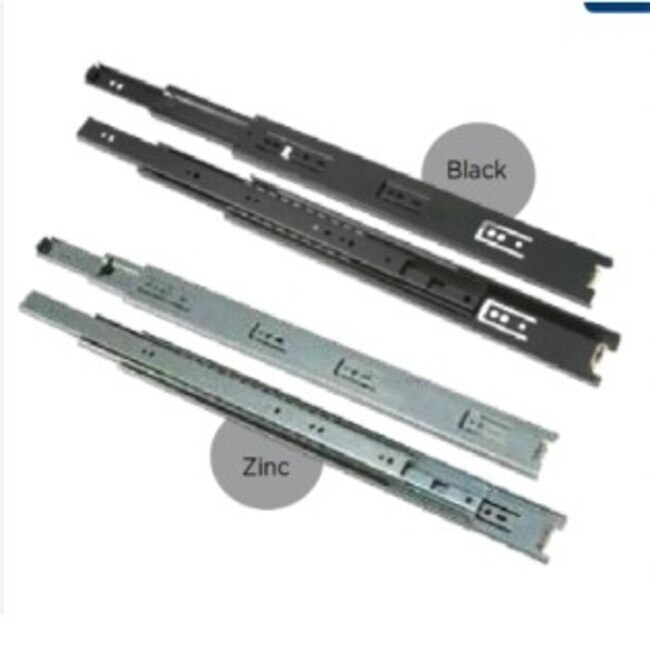
| Zinc-plated steel | Plating coverage, edge protection and corrosion-test evidence | Scratched edges and humid storage areas can expose carbon steel to rust |
| Stainless-steel drawer channel | Stainless grade, ball material, raceway construction and test rating | Stainless steel improves corrosion resistance but does not guarantee higher capacity, quieter travel or longer life |
Ask for the rating test sheet, not only a catalogue figure. It should identify the slide length, extension, mounting position, applied load and opening-cycle count. Check whether the test used a uniformly distributed load; a drawer carrying tools at the front creates a harsher lever load.
Test one loaded sample through repeated openings. Soft-close models need accurate parallel installation and extra closing force; overload or unequal clearances can leave the drawer partly open. For aluminium-profile cabinets, fasten the slide to a rigid bracket or wall, because thin extrusion can deform before the channel reaches its rated load.
Check the Parts, Packaging and Sample Performance Before Bulk Buying
Approve a wholesale order only after the quotation, delivered pack and sample installation agree. A smooth empty drawer proves very little.
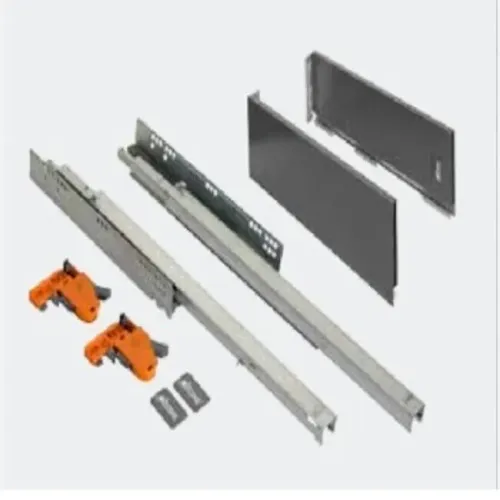
1. Check the quotation for a complete drawer channel pair, not a single rail. It must state length, member count, partial or full extension, load class, finish, mounting-hole pattern, soft-close or push-to-open mechanism, and whether it is a disconnect drawer slide. “Telescopic channel” alone does not identify these specifications.
2. Inspect one sealed pack before accepting the consignment. Confirm the printed length and model match the quotation, both left and right members are present, fasteners and release levers are included, and the bearing races are straight. Reject packs with crushed corners, loose ball bearings, rust, peeling finish, mixed labels or missing installation drawings.
3. Run a drawer slide quality inspection on a sample fitted at the intended drawer width, cabinet depth and side clearance. Load it with the planned contents, not an empty box, then cycle it repeatedly while checking extension, side play, rubbing and noise.
4. Test a soft-close telescopic channel with the cabinet square and both clearances equal. Overloading, unequal gaps or a twisted carcass can stop the latch, leave the drawer partly open or create uneven closing.
Remove the sample after cycling and inspect screw holes, rails and bearing tracks for deformation or fresh wear before approving bulk quantities.
Write a Mumbai Wholesale Specification That Prevents Substitution Errors
Send a one-page drawer channel purchase specification, not a request for “telescopic channels” alone. That term can produce a ball-bearing steel slide with the wrong extension, length or mounting pattern.
- Drawer box width, height and external depth; usable cabinet depth measured from the front mounting face to the first rear obstruction
- Drawer-front thickness, back-panel position and the clear gap on both sides, measured separately in millimetres
- Required opening: partial extension, full extension or over-extension, plus the access needed to reach rear contents
- Working load in kilograms, including the drawer itself, with the load spread across the base rather than concentrated at the front
- Slide type: ordinary ball-bearing or soft-close; state whether push-to-open or another mechanism is required
- Mounting method: side-mounted, bottom-mounted or fixed to brackets, with hole pattern and fixing screw size
- Material and finish: zinc-plated carbon steel for dry interiors, or stainless steel when moisture and salt exposure demand it
- Site conditions: Mumbai humidity, coastal air, cleaning water, condensation and whether the cabinet can trap water
- Installation support: cabinet board thickness, frame construction and the reinforcement available behind each fixing point
Ask the telescopic channels supplier Mumbai for the manufacturer’s installation drawing, rated length-specific load figure and packing details. A quoted 12.5–12.7 mm side clearance is not universal; unequal gaps can bind the drawer or damage bearings.
For aluminium cabinet drawer slides, specify a rigid bracket or reinforced profile wall. Thin aluminium extrusion can deform under load even when the channel rating looks sufficient. Aruna Techno Industries can receive this same detail when you compare wholesale drawer hardware quotations.
Related product
 | Furniture Fittings A Telescopic Drawer Channel, also known as a telescopic drawer slide or telescopic drawer runner, is a hardware component designed to facilitate the... View product → |
Frequently asked questions
How do you measure for a telescopic drawer channel?
Measure from the front mounting plane to the first rear obstruction inside the cabinet. Subtract the back panel, drawer front, stops and plumbing, then choose a channel that fits the remaining usable depth.
What extension type should you choose for a drawer?
Choose full-extension channels when the entire drawer must be accessible. Use partial-extension channels when rear access is unnecessary and the reduced travel suits the cabinet design.
Which telescopic channel specifications should you compare?
Compare the stated load rating, bearing construction, extension length, mounting style and surface finish. Check the rating against the drawer’s loaded weight, not its empty weight.
What should you check before placing a wholesale channel order?
Request a sample, inspect the channel for smooth travel and play, verify the included screws and brackets, and compare the batch packaging with the written specification before approving bulk supply.
How can a Mumbai wholesale specification prevent substitutions?
State the exact channel length, extension, load rating, mounting style, finish, bearing type, handedness if applicable, included parts, packaging and approval-sample requirement.