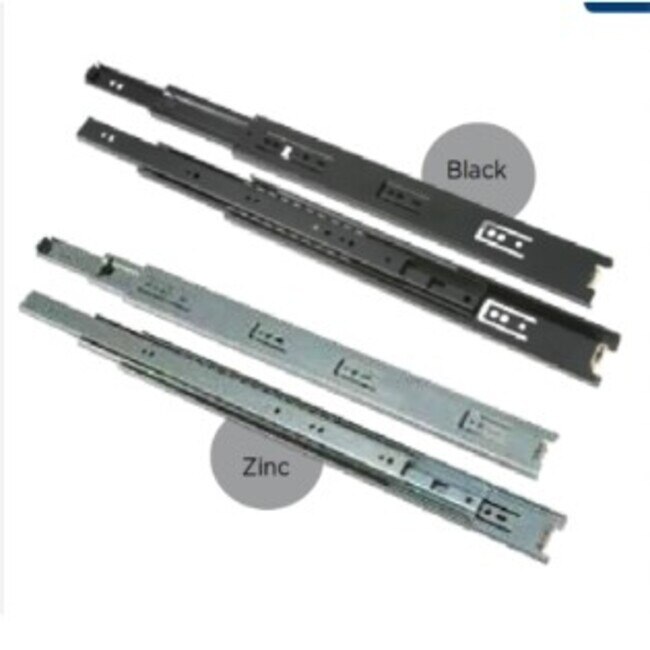
A wholesale drawer-channel order can fail before installation if the quoted length, side clearance, load rating or carton quantity does not match the cabinet design. By the end, you will know how to compare Hyderabad suppliers, specify the right channel, verify compatibility and install each pair without creating binding or premature wear.
Key takeaways
- Compare channel quotes by length, extension, load rating and features.
- Measure drawer depth and side clearance before ordering channel length.
- Match full-extension channels and load ratings to the drawer’s use.
- Install both channels level, square and at equal heights.
Compare Wholesale Quotations by Specification, Not Price per Pair
A low pair price is not a saving if the channel belongs to a different dimensional family. In a telescopic channel wholesale Hyderabad enquiry, send the drawer dimensions and request a like-for-like drawer channel quotation.
| Field | Compare | Ask the supplier to state |
|---|---|---|
| Extension | Partial or full; percentage of drawer opening | Usable extension in millimetres |
| Load | Pair rating under stated width, orientation and cycle count | Test conditions, not only “heavy duty” |
| Clearance | Side-mount gap, often 12.7 mm per side | Installation drawing and tolerance |
| Construction | Two- or three-member design; member thickness | Steel gauge and disconnect feature |
| Finish | Zinc-plated steel versus stainless steel | Coating specification and ISO 9227 salt-spray result |
| Operation | Standard or soft-close mechanism | Soft-close availability and replacement parts |
| Fixing | Hole pattern, screw size and substrate requirement | Approved screws and minimum particleboard strength |
| Supply | Minimum order quantity and carton quantity | Pieces per carton, pack variations and replacement policy |
| Commercials | Unit price, GST, freight and delivery lead time | Hyderabad stock status and landed price |
Treat the stated load as a tested pair capacity, not a safe limit for every drawer. A wide, deep or top-heavy drawer creates extra leverage and racking, while short screws or weak cabinet edges let the channel shift.
Confirm stock before comparing rates; a cheaper quotation with a large minimum order quantity or delayed replacement can cost more than a higher local quote.
Measure Drawer Depth and Side Clearance Before Choosing Channel Length
Measure the closed drawer depth from the inside face of the drawer front to the back panel. Then measure the cabinet usable depth from the cabinet opening to the obstruction at the rear.
Choose a telescopic channel length that does not exceed the smaller measurement; leave room for the front-panel thickness and any rear stop or cable.
| Measurement | What to check | Selection rule |
|---|---|---|
| Drawer depth measurement | Closed drawer box, excluding the front overhang | The channel must fit within this depth |
| Cabinet usable depth | Clear space inside the cabinet, front to back | Channel length must be shorter than this space |
| Side clearance drawer slide | Gap between each drawer side and cabinet side | Follow the selected channel’s drawing, not a generic allowance |
A standard side-mount ball-bearing slide commonly needs about 12.7 mm per side, creating roughly 25 mm between the drawer box and cabinet opening. Confirm this figure on the supplier’s installation drawing because heavy-duty and undermount systems use different gaps.
Too little clearance makes the members bind; too much leaves the drawer loose and weakens the fixing.
Mark both cabinet sides from the same front datum. The channels must sit at equal heights, run parallel and occupy the same front-to-back plane.
Check the fit with the actual drawer front and hardware installed, then load it before approving the measurement: a drawer that slides empty can bind once its weight shifts onto one side.
Match Extension Type, Load Rating and Features to the Drawer
Choose by required opening and loaded mass, not by the word “telescopic.” A two-section telescopic channel suits drawers where rear access is unnecessary; a three-section drawer channel is the better choice when the entire drawer must come forward.
| Choice | What it means | When it applies |
|---|---|---|
| Two-section telescopic channel | Usually provides partial extension | Choose for light or medium drawers where the rear portion can remain inside the cabinet. |
| Three-section drawer channel | Provides longer travel and can provide full extension | Choose for deep drawers, filing drawers or storage where you need access to the back. |
| Partial extension | The drawer opens without exposing its full depth | Choose when lower cost, simpler movement and easier installation matter more than rear access. |
| Full extension drawer slide | The drawer travels far enough to expose nearly its full usable depth | Choose when you must reach rear contents; confirm clearance behind the front panel. |
| Standard operation | Ball-bearing movement without a closing damper | Choose for utility drawers and applications where controlled closing is unnecessary. |
| Soft-close operation | A damper adds closing resistance and pulls the drawer shut | Choose for kitchens, bedrooms and premium furniture, but test it with the actual drawer and front installed. |
| Load rating | The pair’s stated supported mass | Choose a rating above the fully loaded drawer mass, allowing for wide drawers, long extension and uneven loading. |
Do not treat the printed load figure as an endurance guarantee. Ask for pair rating, test evidence and EN 15338 applicability; a wide, heavily loaded drawer can shift or sag even below its nominal rating.
For a soft-close model, reject the fit if the damper cannot pull in an overloaded or misaligned drawer. Specify the fixing screws and substrate too, because weak particleboard edges can let any channel move under repeated loading.
Verify Existing Drawer Compatibility and Install the Pair Square
A channel that fits the drawer depth can still bind if the cabinet is out of square. Measure the closed drawer depth, usable cabinet depth, drawer-box height and front-panel thickness, then confirm the selected channel length does not exceed the usable depth.
Check the installation drawing for side clearance; 12.7 mm per side is common for side-mount ball-bearing slides, but not universal.
Compare the drawer and cabinet diagonals. Unequal diagonals indicate racking that can force the slides apart under load. Confirm both mounting surfaces are solid, flat and in the same front-to-back plane before starting drawer channel installation.
- Mark the left and right slide positions from one fixed cabinet datum. Keep both channels at the same height, parallel to each other and square to the front edge.
- Fit the cabinet members first, using the supplier’s hole pattern and approved screw size. A drawer slide screw fixing driven at an angle, or into a weak particleboard edge, can shift during repeated opening.
- Attach the drawer members with matching offsets on both sides. A quick-release drawer slide must engage fully; partial engagement leaves the drawer unstable.
- Remove machining swarf, paint overspray and abrasive dust. Do not add general-purpose grease, which attracts dust and can interfere with a soft-close damper.
- Test the drawer empty, then with its actual front, hardware and intended load. If movement worsens when loaded, correct the alignment rather than forcing the damper or tightening random screws.
Turn a Hyderabad Stock Check into a Reliable Wholesale Order
A verbal “available” does not reserve stock or prove that the quoted pair matches your specification. Ask each drawer channel supplier Hyderabad buyers shortlist for a written stock, cost and service confirmation against the same part number.
1. Request the physical local stock availability by channel length, extension type, finish and carton quantity. Ask whether the quantity is in Hyderabad, reserved for another order, or due from a factory; obtain the dispatch date for items not on hand.
2. Get a line-item landed-cost sheet showing pair price, MOQ, carton quantity, freight, packing, insurance and GST on hardware wholesale. Confirm the GST rate, tax invoice details and whether freight is taxable before comparing totals.
3. Write the drawer channel delivery lead time as two dates: dispatch and arrival at your site. Ask who bears damage or shortage claims, and require an email confirmation if delivery depends on a future shipment.
4. Put replacement terms on the purchase order. Specify the inspection period, evidence required for bent members or failed soft-close units, replacement turnaround, return freight responsibility and whether unmatched pairs or short cartons are replaced.
Include Aruna Techno Industries in the same RFQ and ask it to confirm these points against the exact channel code, not a similar-looking model. Pay the advance only after the supplier confirms quantity, specification, invoice value and delivery date in writing.
Related product
 | Furniture Fittings A Telescopic Drawer Channel, also known as a telescopic drawer slide or telescopic drawer runner, is a hardware component designed to facilitate the... View product → |
Frequently asked questions
How should you compare telescopic channel wholesale quotations?
Compare quotations by channel length, extension type, load rating, side clearance, finish, soft-close or push-open features, packaging and warranty—not price per pair alone.
How do you choose the correct telescopic channel length?
Measure the drawer box depth and confirm the cabinet’s available depth. Choose a channel that fits without forcing the drawer front or leaving excessive unused space.
How do you match a channel’s load rating to a drawer?
Match the stated load rating to the drawer’s contents and frequency of use, allowing for the drawer box weight and concentrated loads such as cookware or tools.
How do you check compatibility before replacing drawer channels?
Check the existing channel’s mounting position, side clearance, drawer depth, screw-hole pattern and extension type before ordering a replacement pair.
What should you verify in a Hyderabad wholesale order?
Confirm stock, exact channel specifications, quantities per carton, dispatch timing, invoice details, replacement terms and whether the supplied pairs match the approved sample.