A multi-point window lock is only as effective as its gearbox, locking elements, keeps, frame reinforcement and installation alignment. By the end, you will know which window systems it suits, what measurements to send for a quotation, how to test engagement on site and how to compare suppliers without mistaking a central handle for complete security.
Key takeaways
- Confirm sash dimensions, profile, backset and handle height before requesting a quote.
- Choose hooks, mushroom cams, rollers or shoot bolts to match the frame and security need.
- Request compatibility drawings showing gearbox, rod lengths, keeps and fixing positions.
- Test every locking point, handle movement and seal compression before accepting installation.
What a multi-point window lock actually does
A multi-point window lock secures the sash at several positions instead of relying on one latch beside the handle. Turning the handle moves a central gearbox, which drives rods along the sash; this espagnolette mechanism moves hooks, mushroom cams, rollers or shoot bolts into matching keeps in the frame.
| Lock type | Where it resists | What it does not prove |
|---|---|---|
| Single-point casement lock | One latch or bolt near the handle | Resistance at the top and bottom of the sash |
| Mortise lock | A lock case installed in one section of the frame | That several frame positions are engaged |
| Multi-point window lock | Multiple keeps distributed along the sash perimeter | That the frame, screws and keeps can carry the load |
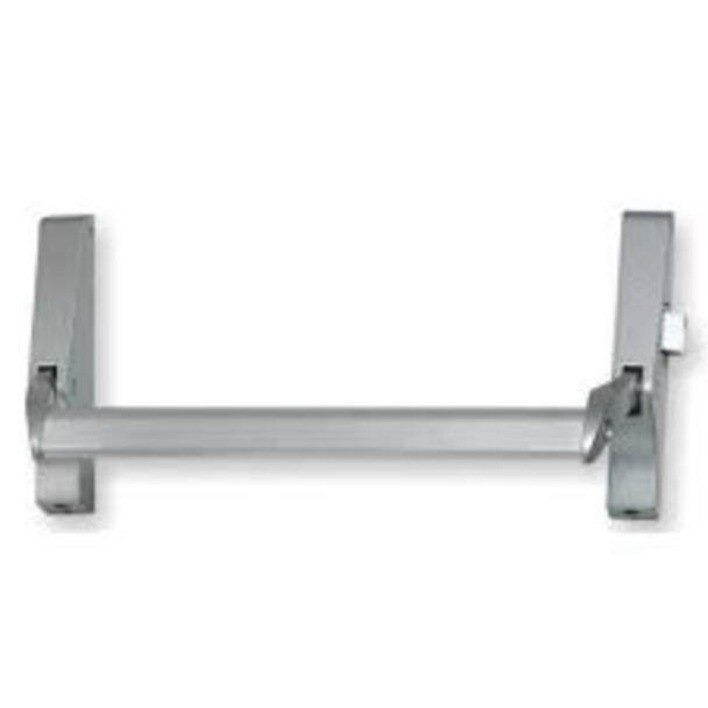
| 3-point panic exit device | Emergency release and controlled exit through three engagement areas | A suitable window-security solution |
A central handle marketed as “high security” is not automatically a multi-point system. The handle may operate only one latch, or the gearbox and rods may be too weak or poorly aligned to create meaningful resistance.
Ask for a drawing showing every locking element, its movement direction, engagement depth and matching keep; “four-way” or “four-sided” can describe transmission rather than four independent attack points.
Security also depends on sash overlap, profile reinforcement, anchoring screws and the installation substrate. A strong lock will not prevent levering if the keep pulls out or the frame deforms. For cylinder-operated versions, specify anti-snap and anti-drill protection and keep the cylinder flush with its escutcheon.
EN 1627 applies to tested complete window assemblies, not a handle alone.
Match the lock to the window before requesting a quotation
The decisive fit factors are the profile section, opening style, hardware channel, sash overlap, available depth and frame reinforcement—not the advertised number of locking points.
A euro-groove channel does not have universal dimensions across every uPVC or aluminium profile. For a retrofit, match the central gearbox, faceplate length, rod positions, keeps and screw locations to the existing system; new fabrication gives more freedom but still requires the profile supplier’s section drawing.
| Window type | Fit conditions to confirm | Common disqualifier |
|---|---|---|
| uPVC casement | Euro-groove dimensions, sash height, backset, reinforcement and keep positions | A gearbox or faceplate that clashes with the profile chamber |
| aluminium casement | Narrow hardware cavity, screw-boss strength, sash overlap and compatible faceplate | Insufficient cavity depth or weak anchoring for the selected keeps |
| tilt-and-turn | Tilt-before-turn mechanism, operating-height limits, corner drives and correct locking sequence | A casement espagnolette that cannot coordinate with the tilt hardware |
| French windows | Meeting-stile clearance, passive-leaf shoot bolts, active-leaf handle position and opening direction | Locking points that collide at the central rebate |
- State whether the job is new fabrication, like-for-like replacement or retrofit alteration.
- Confirm that the frame, reinforcement, screws and substrate can carry the load; more points do not repair weak anchoring or poor sash overlap.
- Request corrosion suitability for the location, including the lock body, keeps, screws and exposed parts. Dissimilar metals and trapped moisture accelerate corrosion.
- For powered windows, specify fail-safe or fail-secure operation, manual override, power-failure response and fire-alarm integration separately. A mechanically secure lock may be unsuitable for escape or smoke ventilation.
The measurements and drawings a supplier needs
A photograph is not enough: a replacement lock can look identical yet fail because its backset or locking-point layout differs. Send a dimensioned drawing of the sash and frame, plus the existing hardware if possible.
- Sash rebate dimensions: measure the rebate depth, width, sash overlap and clearances at several points. Record the sash height and width.
- Gear-strip length: measure the full operating strip and mark every corner transmission, extension and termination.
- Backset: measure from the gearbox faceplate to the spindle centreline.
- Spindle size: record the follower or square spindle dimension and its position relative to the faceplate.
- Gearbox faceplate width: measure the visible strip across the central lock body; also record its thickness and fixing-hole spacing.
- Locking-point positions: dimension each hook, mushroom, roller or shoot bolt from the top and bottom of the sash.
- Handle information: show handle type, fixing-centre distance, height, handedness and whether the handle operates through a euro-cylinder or another cylinder format.
- Frame details: include the keep profile, keep locations, euro-groove or hardware-channel dimensions, and a cross-section of the exact uPVC, aluminium or composite profile.
Mark the opening direction and photograph the lock face-on, the sash edge, each corner drive and every keep. For a motorised unit, add wiring, manual override, power-failure and fire-alarm requirements; mechanical compatibility alone does not prove safe escape operation.
Hooks, mushrooms, rollers and shoot bolts: which engagement suits your frame?
Levering resistance depends on how far each element enters its keep and whether the keep is fixed into sound frame material. Compare the locking geometry, not the number printed in a catalogue.
| Element | Levering resistance | Compression and movement tolerance | Maintenance |
|---|---|---|---|
| Hooks | Strong when deeply captured behind a reinforced keep; engagement depth matters | Pull the sash firmly into the seal, but tolerate less misalignment than rollers | Check hook movement, keep screws and debris in the channel |
| Mushroom cams | Resist lifting when the keep encloses the cam correctly | Adjustable compression suits gasket variation; excessive adjustment raises handle force | Lubricate contact surfaces and inspect cam height |
| Shoot bolts | Strong at the head and sill when their receivers are deep and securely fixed | Provide firm end restraint but demand accurate alignment as the frame moves | Keep receivers clear and check rod travel |
| Rollers | Primarily position and compress the sash; round rollers alone offer limited levering resistance | Best tolerance for small movement and gasket changes | Clean and lubricate the roller-to-keep contact |
Require a drawing showing every point, its movement direction, engagement depth and matching keep. “Four-way” or “four-sided” can describe the transmission rather than four independently resisting points.
At handover, check handle torque, smooth engagement and gasket compression at several sash locations. Too much compression causes stiff operation and wear; too little leaves air and water paths.
For cylinder-operated systems, specify anti-snap and anti-drill protection, proper support and no cylinder projection beyond the escutcheon. Also identify the corrosion grade of faceplates, keeps and screws, especially where trapped moisture or dissimilar metals are present.
How to assess a supplier and accept the installation
Require a Hyderabad supplier to document the exact hardware, test evidence, installation method and service terms before you approve the quotation. Do not accept “four-way” security without a drawing that identifies every locking element, movement direction, engagement depth and matching keep.
1. Request the complete window schedule, section drawings, hardware make and model, cylinder specification, fixing method and maintenance instructions. For handles, check EN 13126-3, but do not treat compliance with that standard as a burglary rating for the complete window.
2. Ask for security evidence for the assembled window, not a lock advertisement. EN 1627 classifies resistance of complete windows and doorsets; request the class and test report, with EN 1628, EN 1629 and EN 1630 methods identified where relevant.
Confirm cylinder protection: the cylinder must not project beyond the escutcheon and should include anti-snap and anti-drill protection where specified.
3. Inspect every sash before glazing or final handover. Operate each one repeatedly, confirm every hook, mushroom, roller or shoot bolt enters its keep without handle force, and check that the key or cylinder turns only when the sash is fully closed.
Reject stripped profile fixings, loose keeps, rubbing seals and a handle that stops short of its normal position.
4. Record the escape arrangement before acceptance. A key-operated cylinder, thumbturn, restricted opening device or child-safety function must not prevent the planned emergency release. Ask Aruna Techno Industries, or any competing supplier, for replacement-part availability, adjustment support and response times in writing.
Related products
 | UPVC Window & Door Hardware UPVC Dooe Hardware View product → |
 | Aluminium Window & Door Hardware Aluminium Window & Door Hardware Aluminium Window & Door Hardware View product → |
Frequently asked questions
What does a multi-point window lock do?
Turning the handle operates a central gearbox and rods that engage several hooks, cams, rollers or shoot bolts with keeps in the frame.
What information does a supplier need for a quotation?
Provide the window system and profile, sash dimensions, opening direction, handle height, backset, locking-point locations and relevant drawings or photographs.
How do hooks, mushroom cams, rollers and shoot bolts differ?
They use different engagement shapes and movement patterns, so the correct choice depends on the frame profile, matching keeps, clearance and required resistance to forced opening.
How should you check a multi-point lock after installation?
Operate the handle with the sash open and closed, confirm every locking point enters its keep, check smooth movement and inspect seal compression without forcing the handle.