A roller that fits the catalogue description can still drag, overload the track or become impossible to replace. You will be able to compare suppliers, confirm compatibility from measurements, verify load and durability claims, and approve a complete door-and-track system rather than choosing on a generic “heavy duty” label.
Key takeaways
- Identify the door system before comparing roller products.
- Send door weight, dimensions, track details and clearances with every quote request.
- Check rated load, wheel material and roller configuration against the complete door weight.
- Treat soft-close as a matched mechanism, trigger and track system.
Start by Identifying the Door System, Not the Product Name
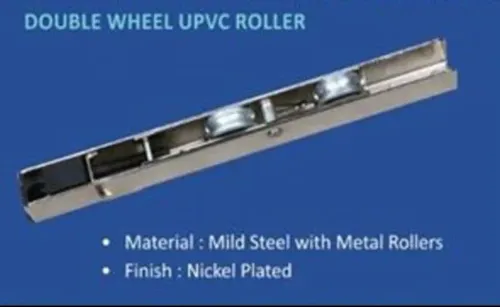
Choose the component for the opening, not the catalogue label. A sliding-door roller carries a full-height aluminium or framed door; a sliding-window bearing serves a sash. A wardrobe soft-close roller belongs to a furniture shutter, while a track assembly provides the running path.
A synchronised sliding system links two or more panels so they move together.
| Opening | Component | Requirement |
|---|---|---|
| Full-height aluminium door | Sliding-door roller | Match frame cavity, track and leaf mass |
| Framed glass door | Roller and glass carrier | Match glass thickness, carrier and fixing method |
| Wardrobe shutter | Wardrobe soft-close roller | Match shutter weight, soft-close trigger and furniture track |
| Heavy architectural panel | Rated roller and track assembly | Verify load, adjustment, anti-lift and track straightness |
| Linked panels | Synchronised sliding system | Confirm panel spacing, timing and compatible hardware |
Labels such as Domal, Uno, 37 mm series and 3/4-inch series do not prove compatibility. Ask for a dimensional drawing showing wheel diameter, tread, axle, housing, mounting holes, total height and adjustment range; complete a track assembly comparison against the installed groove and running surfaces.
For glass, verify the complete load path: roller body, clamp or fixing screw, glass carrier, compatible glass thickness, frame, track and anti-lift or anti-drop provision. A high-capacity wheel cannot compensate for an inadequate carrier or fixing method.
Aluminium doors need frame and track fit; framed glass doors need secure retention; wardrobes need controlled closing; heavy panels need documented load capacity.
Send a Complete Measurement Sheet Before Requesting a Quote
A replacement quote is useful only when the supplier can match the part to the opening and track. Send a complete measurement sheet before asking for a price. Include:
- Door or shutter mass, width, height and number of panels
- Wheel diameter, wheel material and wheel tread profile
- Roller housing dimensions, axle diameter and total roller height
- Track profile, groove width and both running-surface dimensions
- Mounting-hole spacing, adjustment range and adjustment direction
- Clearance above and below the panel
- Panel overlap and seal compression
Request a roller dimensional drawing showing every critical dimension. Do not rely on a catalogue photograph; it can hide the axle height, housing depth or hole position.
| Evidence | What to check | Why it matters |
|---|---|---|
| Catalogue label | Series name or advertised wheel diameter | Matching names do not prove fit |
| Dimensional drawing | Tread, axle, housing, holes and total height | Reveals interference with the track or sash |
| Installed measurement | Groove, running surfaces and clearances | Confirms the drawing matches the opening |
Measure the existing track’s groove and running surfaces, then check that the track is straight and level. Record any bow, slope or out-of-square condition because an adjustable roller cannot correct a defective track.
Compare the drawing with the installed roller, including hole position and adjustment direction. Two rollers with the same wheel diameter can still fail when their tread, axle height or housing interferes with the track or sash.
Verify Load Rating, Wheel Materials and Roller Configuration
Calculate the complete leaf mass before accepting a “heavy-duty” roller: glass, frame, handles, locks, seals, seal compression and every attached hardware item count. Divide that mass by the roller count only as a starting point; an imperfect track and unequal wheel loading can overload one roller.
Request these figures for the exact wheel, bearing and mounting configuration:
- Maximum leaf mass
- Allowable per-roller load rating
- Minimum number of load-bearing rollers
- Permitted load imbalance
Compare wheel materials against the actual site conditions, not just the catalogue label.
| Material | Noise and track effect | Main limitation |
|---|---|---|
| Nylon | Quiet and protective to aluminium tracks | Lower capacity and possible dust wear |
| Acetal | Quiet, low-friction and track-friendly | Request the specific grade and load limit |
| Steel | High capacity | More noise and track damage if alignment or cleanliness is poor |
| Stainless steel | Corrosion resistance with high capacity | Higher cost and possible noise or marking |
Ask for the material grade, then identify whether the bearing is sealed, shielded or open, its size and seal type, and whether it rotates independently of the wheel. For exposed or semi-exposed Bangalore installations, request ASTM B117 or ISO 9227 results; salt-spray hours screen corrosion resistance but do not predict service life.
Compare single-wheel, twin-wheel, tandem and adjustable assemblies. Adjustment can correct limited sag or rubbing, but it cannot fix a bowed or out-of-square track. For each option, ask for the complete roller-and-track load evidence rather than an unloaded wheel test.
Treat Soft-Close as a Complete System, Not an Upgrade Wheel
Choose a soft-close roller when you need controlled closing over a defined distance, not merely easier movement. Ordinary rollers prioritise free rolling; soft-close units add resistance and controlled deceleration, so they need a matched track system.
| Option | Operating principle | Suitable use |
|---|---|---|
| Ordinary roller | Low rolling resistance and free movement | Frequent opening where a user controls the door |
| Soft-close roller | Added resistance, damper control and deceleration | Doors that need quieter, controlled closing |
Before approving the assembly, ask for:
- Maximum door weight, damper adjustment range and closing force
- The required receiver or trigger, plus its position
- A compatible soft-close track, stopper and receiver
- Installation limits for track straightness and level, parallelism and sash clearance
Confirm that the roller, soft-close mechanism, track, stopper and receiver are designed to operate together. Buying the roller alone can leave the closing action inoperative or create excessive drag.
Soft-close and adjustable rollers cannot repair a bowed track, poor level, incorrect parallelism, excessive seal compression or insufficient sash clearance. Ask for the permitted tolerances; forcing a misaligned door through the damper causes recurring drag and premature failure.
Obtain cleaning and lubrication instructions. Wet oil or grease on an exposed track retains dust and forms abrasive paste, so ask whether the system runs dry and which cleaner or lubricant is safe for the wheel polymer, bearing seals, anodised or powder-coated aluminium and glazing seals.
Score Suppliers on Proof, Availability and First-Article Control
After technical fit is confirmed, compare suppliers on evidence and service, not catalogue claims. Give each supplier a score out of five for every item below and record the evidence behind it.
| Criterion | What to score | Evidence to request |
|---|---|---|
| Supplier stock depth | Stock held in Bangalore or nearby | Current quantity and stock date |
| Minimum order quantity | Suitability for your project volume | Written MOQ |
| Delivery coverage | Sites and pin codes served | Delivery terms |
| Quoted lead time | Promised dispatch and arrival | Dated quotation |
| Technical support | Response to fit and load questions | Named contact |
| Installation guidance | Drawings, limits and instructions | Installation document |
| Replacement availability | Access to replacement rollers | Part number and replenishment commitment |
Require an identifiable part number, spare-roller stock, replenishment lead time and interchangeability rules for every approved profile. Ask for durability evidence on the complete roller-and-track assembly, not an unloaded wheel. If the supplier cites EN 1527 durability testing, require the tested configuration, applied load, adjustment condition and durability classification.
Run a production-size sample at its specified load. Measure handle opening force before and after repeated cycles, then inspect for:
- Wheel flat spots, bearing play and track marking
- Loose fasteners or altered adjustment
- Changes from the retained approved sample
Require first-article approval after any change to wheel compound, bearing source, axle plating, mould, factory or country of manufacture. Aruna Techno Industries belongs in the same comparison when it supplies this dimensional, load, test and replacement evidence.
Related products
 | Furniture Fittings Wardrobe Soft Close Rollers ensure smooth and silent sliding of doors, enhancing the overall user experience. View product → |
 | Aluminium Slim Partition Profile The Synchro Sliding System is a modern sliding door mechanism that allows two or more doors to open and close simultaneously with smooth,... View product → |
Frequently asked questions
Why identify the door system before selecting sliding door rollers?
A full-height aluminium or framed door, sliding window sash and wardrobe shutter use different roller types, loads and track arrangements. Match the roller to the opening rather than relying on a catalogue label.
What measurements should you send a Bangalore supplier before requesting a quote?
Provide the door’s width, height, estimated weight, frame material, panel thickness, track profile, roller pocket dimensions, wheel diameter, adjustment range and available clearances. Include photographs and a drawing of the existing assembly.
How do you verify whether sliding door rollers are suitable for the load?
Compare the manufacturer’s rated load per roller with the complete door weight, then check the wheel material, bearing construction, roller count, adjustment method and track compatibility.
Is a soft-close roller enough to create a soft-close sliding door?
No. Soft-close operation requires a compatible damper, trigger or activator, installation position and track geometry. Confirm that the complete mechanism is designed for the door’s weight and travel.
How should you compare sliding door roller suppliers in Bangalore?
Score each supplier on technical documentation, batch or part identification, local stock, replacement availability, sample testing, dimensional consistency and control of the first production article.